FROM WASTE TO RESOURCES: THE ZERO POLLUTION ROADMAP

FROM WASTE TO RESOURCES: THE ZERO POLLUTION ROADMAP
AN INDUSTRY THAT NEEDS TO CHANGE
There was a time when furniture was made to last for generations. Design was a commitment to permanence.
Today, the reality is very different. Every year, more than 10 million tonnes of furniture end up in landfill across Europe. It is the equivalent of throwing away an entire living room every second.
When we came across this figure, one question became impossible to ignore:
What role do we play in this story?
At EMOBOK, the answer was clear from the very beginning. We do not want to be just another number in those statistics. We want to be part of the solution.
💡 ¿Sabías que…?
El término “obsolescencia programada” nació en los años 30, como estrategia empresarial de diseñar y fabricar productos con una vida útil intencionadamente corta, de modo que se vuelvan obsoletos o irreparables tras un periodo de tiempo determinado. Esto obliga al consumidor a comprar un nuevo producto. En Emobok estamos haciendo justo lo contrario: “longevidad programada”. Diseñar para que algo sea eterno es el acto de rebeldía más sostenible que existe.
But a product’s durability loses its meaning if the process behind its creation is not equally responsible. We realised that our commitment had to begin long before a piece of furniture left the factory.
The answer had been right in front of us all along: the board.
For decades, the industry accepted waste as an inevitable outcome. At EMOBOK, we chose to redefine it. To us, waste is simply a design challenge the world has yet to solve.
Sometimes, innovation does not begin by asking what we want to create, but rather:
What can we do with what the system has chosen to discard?
HOW ZERO POLLUTION BEGAN
To answer that question, we first had to take a critical look at our own manufacturing process.
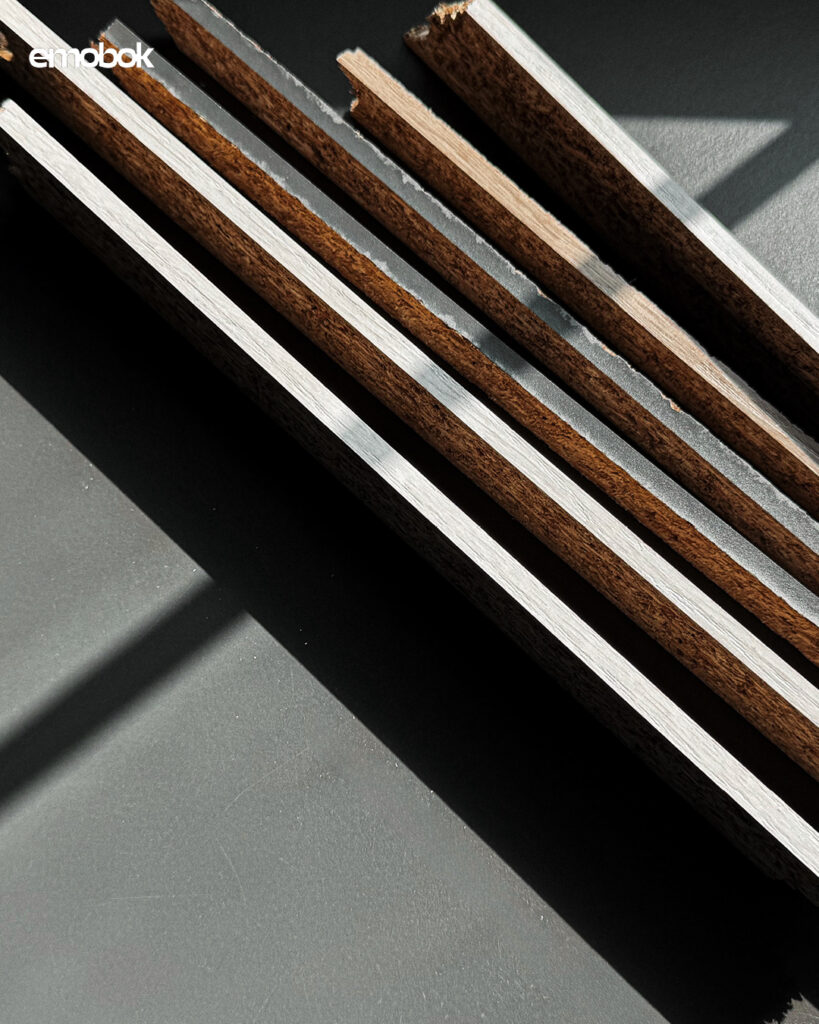
When we examined our production plant more closely, we uncovered an uncomfortable reality: even after optimising every possible board cut, between 15% and 20% of our raw material never became part of the furniture we produce.
That percentage represents far more than offcuts. It carries an environmental cost that creates a domino effect throughout the value chain. It represents raw materials that have already consumed water, energy and industrial resources long before reaching our factory. It reflects transport emissions generated to deliver materials that will never be used, together with the carbon footprint associated with their disposal and treatment.
The result is a striking reality: for every five lorries delivering board materials to furniture manufacturers, the equivalent of one lorry ends up as waste. Another journey begins towards recycling or disposal facilities, generating additional CO₂ emissions while requiring complex treatment processes for materials such as melamine.
Seeing this completely changed our perspective.
The problem was not simply the material we had to discard. It started much earlier and continued long after it left our factory.
There had to be another way.
There had to be Zero Pollution.
Instead of accepting waste as the end of the process, we decided to make it the beginning.
Zero Pollution is our contribution to addressing what has long been the industry’s blind spot: the 20% of material traditionally considered unavoidable waste. Our answer is to develop new recycled materials for office furniture, produced entirely from the waste generated by our own manufacturing process.
Our ambition is to move beyond the traditional linear model towards a truly circular one, where boards and other production waste can be recovered and reused again and again, transforming what was once discarded into a valuable resource.
But our vision extends beyond EMOBOK. Our goal is for this solution to benefit the entire furniture industry.
Zero Pollution is an R&D&I initiative led by EMOBOK, with a total investment of €574,318, placing sustainability at the heart of our business strategy. The project is supported by CDTI (Centre for the Development of Industrial Technology) and co-funded by the European Regional Development Fund (ERDF) under the Multi-Regional Operational Programme for Spain 2021–2027.
The project is being developed in collaboration with CETEM (Furniture and Wood Technology Centre), one of Europe’s leading research organisations specialising in the furniture and wood sector. This research programme reinforces EMOBOK’s commitment to building a more innovative and responsible industry, fully aligned with sustainability principles and United Nations Sustainable Development Goal 9: Industry, Innovation and Infrastructure.
♻️ Did you know melamine is one of recycling’s toughest challenges?
Melamine is one of the most widely used materials in contemporary furniture, but also one of the most difficult to recycle. Because of its thermosetting resins, it has long been regarded as a one-way material, with no practical route back into the production cycle.
At EMOBOK, we have chosen to challenge that assumption.
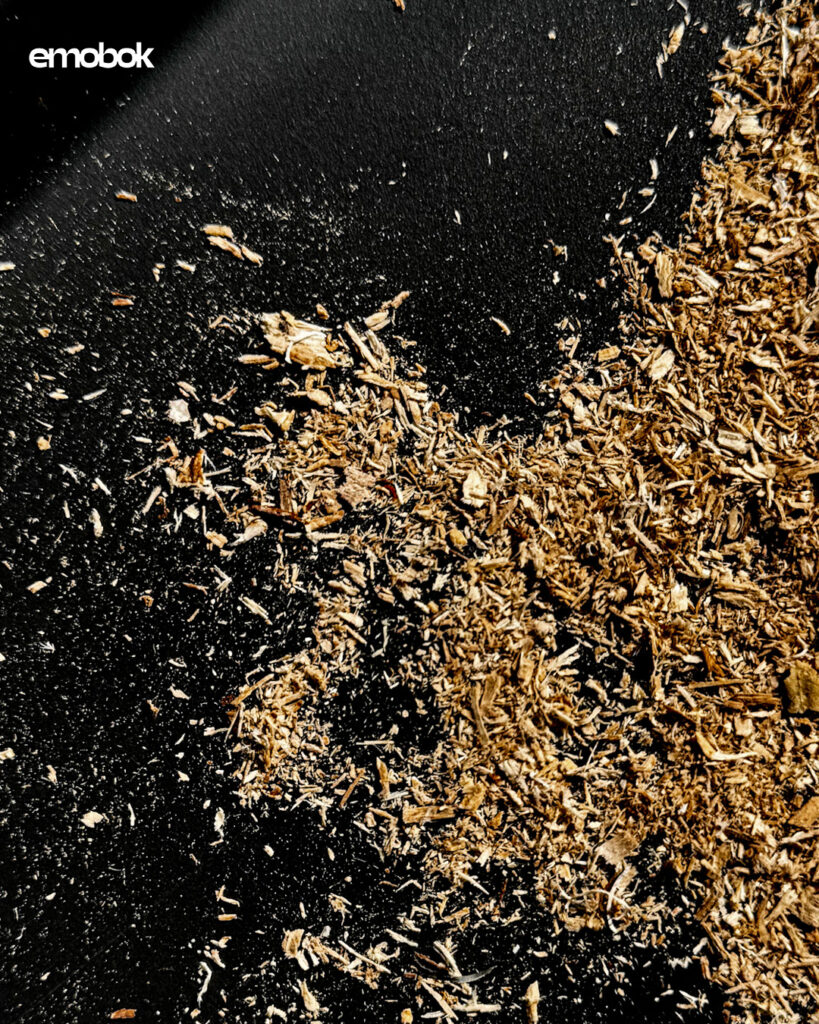
Through Zero Pollution, we are researching new ways to give melamine waste a second life.
And perhaps a third.
Or even a fourth.
WHAT LIES AHEAD
No solo observamos el futuro; lo estamos construyendo.
Nuestro objetivo es desarrollar una nueva línea de materiales técnicos de alta prestación, fabricados íntegramente a partir de nuestros propios residuos de producción y 100% reciclados.
Este enfoque nos permite cerrar el ciclo dentro de nuestra propia cadena de valor y avanzar hacia un modelo real de economía circular. Pero el reto va más allá del reciclaje convencional: en Emobok estamos investigando cómo dotar a estos nuevos materiales de propiedades técnicas avanzadas, como capacidades acústicas, alta resistencia al fuego y nuevas prestaciones no estructurales. Esto permitirá su aplicación en oficinas, espacios públicos o proyectos contract con exigencias técnicas superiores.
Dentro de esta exploración de materiales derivados, uno de los desarrollos más interesantes es la creación de un filamento propio para impresión 3D generado a partir de nuestros residuos. Este avance permitirá fabricar accesorios, componentes o piezas personalizadas utilizando recursos que originalmente iban a ser descartados. En otras palabras: convertir el residuo en una herramienta de creación infinita al servicio de una producción responsable (ODS 12).
PREPARANDO EL SECTOR PARA EL NUEVO MARCO 2030
EL RETO DE MAÑANA
Sabemos que nos queda mucho por hacer.
Y precisamente ahí está nuestra motivación.
Cada día es una oportunidad para mejorar un proceso, encontrar un material más amigable o reducir nuestra huella.
Porque la sostenibilidad no es una meta donde se llega y se planta una bandera: es una búsqueda constante.
Lo que hemos hecho hasta hoy forma parte de nuestra historia, pero lo que estamos inventando ahora puede formar parte del futuro de todo el sector.